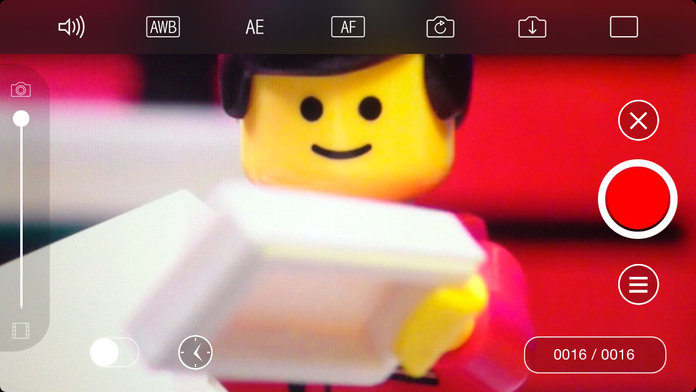
Stop Frame is a technique in which you physically manipulate an object tro create the illusion of motion. To creathe this your chosen object is required to be moved little by little and taking individually photographed frames, this will produce the illusion of motion when you have played the frames in a continuous series, which can be done through the use of computer technology by putting the series of frames into Stop Motion software or even into Adobe Premiere. Movable jointed clay figures are often used in stop motion due to their greate ease of movement. Although they are useful it is not always necessary to use figures and in turn many stop motion films can involve using humans which can create interesting outcomes. here is an example of a stop frame animation that uses this technique.
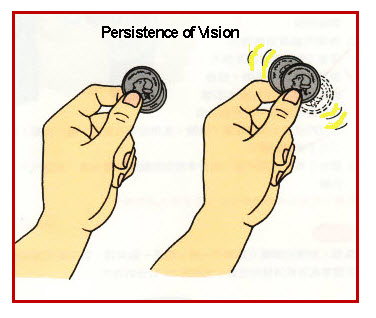
The Persistence of vision is a theory that an afterimage is thought to persist for around one twenty-fifth of a second on the retina, this is believed to be an explanation for motion perception. The true reason for perception of continuous light is Flicker fusion.
A critical part of understanding the visual perception phenomena is that the eye is not a camera and in turn does not see in frames per second. In other words this vision is not as simple as light registering on a medium, because the brain has to make sense of the registers data the eye has provided and constructs a coherent picture of reality. Joseph Anderson and Barbara Fisher argue that the phi phenomena privileges a more constructionist approach to the cinema.
Frame rate or better known as frames per second / FPS, is the rate at which a device produces unique consecutive number of images called frames. This term is used to apply equally well to film and video cameras, computer graphics. Most often expressed in frames per second it can also be expressed as progressive scan monitors in hertz.
The motion picture industry utilises traditional film with a standard filming and projection format of 24 frames per second. although Historically, 25 fps was used in some European countries as shooting at a slower frame rate would create a faster motion when it was projected, when shooting at a frame rate higher than 24 fps it creates a slower motion once projected. a further example of the historical experiments within frame rate is that they were not widely accepted by Maxivision 48 and Showscan, this was developed in 2001 by Douglas Trumbull, Special effects creator for Space Odyssey.
Here is an example of how Frame Rate orks giving a comparison of the differences bettween more and fewer frames. as you can see from the image the piece showing the use of 30 fps is much more clear and gives a smoother effect, where as the piece used for 15fps is much more blurred within the motuion of it. this is why more framesd are used as it creates a better picture and makes it much smoother too watch overall for the viewer meaning you dont get the motion blurring.
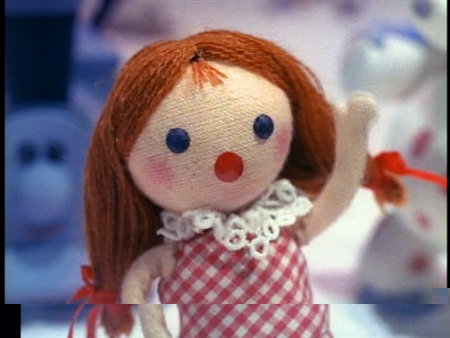
For a long time now Stop Motion has been used within the film industry creating many memorable classic films that have kept many generations entertained. The process is done through the use of cameras, taking thousands of stills frames and then in each altering the position of your photographed object slightly, in hopes of when they have been linked together and played it should give the appearence of natural motion. here is an example of one of the earliest TV Animations which was Rudolph the Red-Nosed Reindeer. it was a Christmas television special produced in stop motion animation by Rankin/Bass, and directed by Larry Roemer and Kizo Nagashima. The special was based on the Johnny Marks song "Rudolph the Red-Nosed Reindeer" which was also based on the 1939 poem of the same name, which was written by Marks' brother-in-law, Robert L. May. Since 1972, the TV special has aired mostly on CBS television stations.
The PJs is an American stop-motion animation television series, that was created by Eddie Murphy, Larry Wilmore, and Steve Tompkins. It portrays the life of an urban public housing project, that was modeled after the Brewster-Douglass housing project in Detroit.The series starred Eddie Murphy, and was produced by Imagine Entertainment by Ron Howard and Brian Grazer, The Murphy Company and Will Vinton Studios in association with Touchstone Television.
The show aired 43 episodes during its 3-year running period. With each taking over 2 months to produce, this owed to the laborious stop-motion process having to film the each episode frame by frame to create a smooth and natural looking effect. Although After 2 seasons on Fox, the show had moved. Its high budget and declining ratings led to its cancellation in 2001; with its final 2 episodes not airing until 2003.
South Park is an American animated sitcom intended for a mature audience. it was created by Trey Parker and Matt Stone for the Comedy Central. its best known for its crude language and dark, surreal humor that satirizes a varied range of topics. The ongoing narrative revolves mainly around four boys Stan, Kyle, Eric, and Kenny and their bizarre adventures in and around the Colorado town. it was originally developed from two animated shorts they created in 1992 and 1995. With the latter becoming one of the first Internet videos to go viral, which in turn led to its production as an ongoing series. it debuted in August of 1997 creating huge great success, and earning the highest ratings of any basic cable program. The ratings have varied but it still remains to be one of Comedy Central's highest rated shows, and is slated to air through at least 2016. Although it has the appearence of a stop motion cut out series, it is infact only The pilot episode that was produced using cutout animation. All episodes created from then on were done utilising a software that emulated the cutout technique.
Channel Idents
A Channel Ident, or better known as a channel logo is what is mostly seen during a commercial break, or before something started, although mainly done through 3D animation or another means. Sometimes they have been created by stop motion animation for example on channels such as E4 they have used stop motion within some of there commercial breaks, before they became a more mainstream music channel MTV aso used stop animation in some of their Idents. not may channel idents use this process very often as it is highly time consuming, and can take months to produce due to the large amount of frames that are necessary.
Advertising
Advertising is a key part of the media industry at this point in time as it is the main way to get recognised and makes people want to purchase your product , all thorugh bold and captivating visual imagery. now many adverts these days use either 3D animation or Drawn Animaton as well as live action which are all useful ways of advertising on television yet on occasion some will use Stop Motion animation which although takes a large amount of time due to the lengthy process, it can also be quite effective in advertising things for example, the video above shows a recent john lewis home insurance advertisement which was done through the use of stop motion animation. the animation was directed by Dougal Wilson and produced by Ewen Brown, and due to the scale of the project it took an incredible amount of time and effort to create.
Music Videos
Music videos are highly popular within the media industry and can generate are large amount of profit and show a musicians artisitc and unique style through video. many music videos have been done in a similar manner to that of movies although on occasion some will show through a different matter and utilise styles of animation such as Stop Motion which can be seen in the Music Video Sledgehammer by Peter Gabriel, which was produced by Danel Lanois. The video is highly eccentric and extravagant relying on a bold use of color and objects which is highly fitting with the style of the video along with the music.
Another example of a Music Video that uses stop motion is in your arms by Kina Grannis (shown above), the video was made entirely through the use of jelly beans. the idea appears very complex and complicated due to the scale on which you have to work with. upon researching it appears that the video took approximately, 22 months, 1,357 hours, 30 people, 2 ladders, 1 still camera and 288,000 jelly beans to complete the final outcome.
Cell Phones
While researching into mobile phones i couldnt find anything in particular that utilised Stop Motion animation as a means of creating start up screens and in mobile technology. although within technology you can find many apps that allow you to create your own stop motion animations or give you tutorials on the processes and different ways on procducing this animation style.
Websites
Similar to that of Cell Phone there isnt really anywhere spcific that utilises Stop Motion technology within its design, although ypu will fing many websits online dedicated to the work of stop motion for example some websites will have hndred of videos which have been created by users and then uploaded to the site, where as other websites will detail how you can make your own stop motions and how to become good at it by harnessing certain skills. in some areas you may even be able to download software to use on your system which will make creating your own mini film a lot easier.
Aardman Animations, which is also known as Aardman Studios, is a British animation studio based in Bristol, United Kingdom. The studio is best known for its films made utilising stop-motion andclay animation techniques, particularly those that feature Plasticine models such as Wallace and Gromit. although It had entered the computer animation market with the release of the film Flushed Away.
Wallace and Gromit
Wallace and Gromit is a British stop-motionfranchise. That was created by Nick Park from the company Aardman Animations, the series consisted of a series of four short films and one feature-length film. The series centres on Wallace, the absent-minded inventor who is enthusiastic about cheese, along with his friend Gromit, a silent yet intelligentdog. Originally Wallace was voiced by actor Peter Sallis, but this role has been handed down to Whitehead as of 2011. although Gromit remains silent, making communication through a means of bold facial expressions and simple body language.
Because of their high level of popularity, the characters have been described as a positive international icon of British culture in particular and British people. The News has called them some of the best-known stars to come out of the UK. Wallace and Gromit has now been translated into over 20 languages and is particularly big in Japan, as well as in its native Britain and across Europe and the United States.
Chicken Run
Chicken Run is a British stop-motion animated comedy film made by Aardman Animations studios and was directed by Peter Lord and Nick Park. It was the first feature-length film that Aardman had created and the first produced in a partnership with the company DreamWorks, which co-financed and distributed the film. Chicken Run received positive reviews, and was a box office hit.
The plot centred around a band of chickens who meet a smooth-talking Rhode Island Red named Rocky, who they believe to be there only escape from certain death when the owners of their farm decide to move onto selling chicken pot pies instead of selling eggs.
Tim Burton was born August 25th 1958, and is an American film director, producer, and stop motion artist. He is widely known for his dark, gothic, horror and fantasy films such as Beetlejuice, Edward Scissorhands, The Nightmare Before Christmas, Sleepy Hollow, and The Corpse Bride
Burton has worked may times with actors such as Johnny Depp, who he has become a close friend with since their first film together. He has also wrote and illustrated a poetry book known as The Melancholy Death of Oyster Boy & Other Stories, which was published in 1997, and aswell as this a compilation of his drawings, sketches and other art, was released in 2009. He has directed around 16 films and produced 12 as of 2012. His latest film being the Big Eyesm, a biographical drama about Walter Keane and his wife Margaret.
The Nightmare Before Christmas
One of his best known Stop motion pieces Burton wrote and produced although he did not direct, due to schedule constraints on Batman Returns, The Nightmare Before Christmas for Disney, it was originally meant to be a rhyming children's book. Which was directed by Henry Selick and written by Caroline Thompson, it was based on Burton's original story, world and characters. Receiving highly positive reviews for the film's stop motion animation, bold and eccentric musical score and original storyline creating a box office success, grossing $50 million. He had collaborated with Selick again for James and the Giant Peach, which Burton co-produced. The film helped to generate a renewed interest in stop motion animation.
James and The Giant Peach
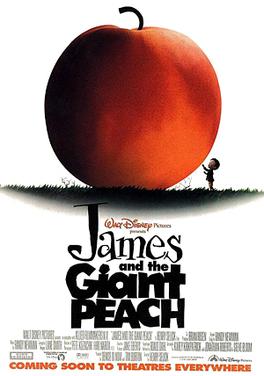
In 1996, Burton and Selick reunited for the musical fantasy film James and the Giant Peach. Based on the book by Roald Dahl. The film created a combination of live action and stop motion footage, starring Richard Dreyfuss, Susan Sarandon among others, with Burton producing and Selick directing. The film had mostly been praised by critics, and was nominated for the Academy Award for Best Original Musical or Comedy Score.
Frankenweenie
In 2012 Burton remade his 1984 short Frankenweenie as a feature-length stop motion film, distributed by Walt Disney Pictures. He said, that the film was based on a memory that he had while growing up and his relationship with a dog that he once had. The film was released on October 5, 2012 and met with positive reviews. It is his fourth stop-motion film he has produced and the first of those four that is not a musicalpiece. the film tells the tale of a young boy named Victor who loses his dog Sparky, using the power of electricity he resurrects him, but is then blackmailed by his peers into revealing how he had done this. hoping to reanimate their deceased past pets and other creatures, which results in chaotic mayhem. The tongue-in-cheek film contains many a reference and parody related to the book, past film versions.
BrothersStephenQuayand Timothy Quay are esteemed filmmakers, film directors and animators. They are identical twins most famously known as both either Brothers Quay or the Quay Brothers. Indeed their collaborative stop-motion animations are extremely well known for the ways in which they have been influential to the field.
when the brothers first moved to London from the States, their stop - motion films had introduced an entire generation of viewers to the lyrical darkness that was not often associated with animation. This was heavily Influenced by the Central European writers and artists reflecting the dark psychology resulting from a century of industrial warfare, and surrealist art. they have been heavily inspired by figures like the Polish killed by a German Nazi officer Bruno Schultz, it is also noteworthy has also influenced other famous noted individuals such as film director Tim Burton and the American-born British screenwriter, Terry Gilliam. It is quite difficult to distinguish between the brothers on who exactly in the pair that make. as they are both deeply spread across the media industry, although by looking at their individual trade, one skill that separates them slightly is that Stephen has done acting on top of everything else. In their later series of work, the Brothers have expanded on the use of stop - moton filmmaking by icluding it within live choreography involving installation, and even ballet. In there piece the Sandman, a televised ballet starring the Spanish prima ballerina Tamara Rojo and the Soviet-born dancer Irek Mukhamedov, the image-movements of puppets are reproduced in the jerky staccato forms of the dancers.
 Stop Frame is a technique in which you physically manipulate an object tro create the illusion of motion. To creathe this your chosen object is required to be moved little by little and taking individually photographed frames, this will produce the illusion of motion when you have played the frames in a continuous series, which can be done through the use of computer technology by putting the series of frames into Stop Motion software or even into Adobe Premiere. Movable jointed clay figures are often used in stop motion due to their greate ease of movement. Although they are useful it is not always necessary to use figures and in turn many stop motion films can involve using humans which can create interesting outcomes. here is an example of a stop frame animation that uses this technique.