What is Stop Motion Animation and How does it work?

Stop Motion, is the process of manually
manipulated an object to appear as if it is moving. The
creation of this process is credited
to Albert
E. Smith
and J. Stuart Blackton for Vitagraph’s ‘The Humpty Dumpty Circus’ in 1897.
The
process is done
by moving your chosen object into slightly different positions and taking a photograph each time as you do
this . Which when you play these photos within a sequence it should appear as
if it is moving. A
good object to use within Stop Motion is either move able jointed dolls or clay
models as they are easier to be used due
to the ease of their re-positioning.
If
plasticine is used then the name used becomes Claymation which is a highly used
method in the Stop motion technique and
you can see this through many well known films e.g. Wallace and Gromit and
Chicken Run which was created by Nick Park and Aardman Animations.
Within
Stop motion it is not always necessary to use objects within your animations,
this is because you can also use humans or household appliances which tend to
be used to create some form of comedic effect.

Where did the Process of Stop Motion Animation originate from, and How did it Evolve?
Joseph Plateau - The
Process of Stop Motion began when a man named Joseph Plateau patented his
device known as the Phenakistoscope in
1832. born October 14th 1801 and died September 15th 1883, he was
a Belgian physicist who was the first person to demonstrate the
illusion of a moving image. He created this by using counter rotating disks
with a series of repeatedly drawn images each with small alterations of motion
on one and then a series of regularly spaced slits so when they were both
rotated at the correct speed the synchronisation of the windows
created an animated effect. In
1829 he submitted a doctoral thesis to his mentor, it was only 27 pages by
formulated a large amount of important conclusions. It contained the first
results into the research of the effect of colors on the retina and also the
mathematical research into the intersections of a revolving curve. When he
investigating counter rotating disks he named these Anorthoscopic
discs.
William
Horner - Born during 1786 and died on the 22nd of September 1837, he was a
British mathematician who looked extensively at functional equations and the
approximation theory. Although known greatly for his mathematical abilities and
studies he can also be attributed for the creation of the zoetrope, or in 1834
this was known as the Daedaleum. The
zoetrope is a device that creates the illusion of movement from rapid rotation
of static images. The term zoetrope was taken from the Greek language meaning ‘zoe’
which means “life” and ‘tropos’ which means “turn”, this word can
be seen to also mean the “wheel of life”. This
invention consists of a cylindrical object with vertical slits cut into the
sides. On the inner surface of the chamber was a series of images which when
the cylinder was spun and the user was looking through the slits the image
would appear to be moving.
Emile
Reynaud - Born 8th of
December 1844 and 9th of
January 1918. he was a French pioneer who was responsible for the first
projected animated films. He also created the Praxinoscope in
1877.
This
device was the successor of the zoetrope, being very similar it also used a
strip of images placed along the inside of a cylindrical object which is then
spun. But although it was similar it improved on some aspects by replacing the
vertical slits with a series of mirrors on the inside. This was done so the
reflection of the images would appear stationary in position once the wheel was
turned, so when it was rotated they would appear to create the illusion of
motion and would create a brighter less distorted picture.
As
well as this device in 1889 Emile also developed the invention of Theater Optique
which was an improved version capable of projecting images on a screen from a
much longer roll of images. This also allowed him to show hand-drawn cartoons
to a much larger audience. But was later shadowed by the photographic film
projector created by the Lumiere
Brothers.
Eadweard
Muybridge - Born 9th of
April 1830 and died 8th of
May 1904. he was an English photographer well known for his work in
photographic studies of motion and within the motion picture projection.
He is
well known for his work involving animal locomotion in 1877 and 1878 which he
used a series of cameras to capture the motion in stop motion photographs. He
is also known for his Zoopraxiscope
which was a device for projecting motion
pictures that predated the film strips used within cinematography, he
patented this within 1879 and may be considered as the first movie projector.

The Zoopraxiscope
projected imagery on glass disks which
once spun in rapid succession would give the impression of movement. Initially
the imagery was painted onto glass as silhouettes but was later changed between
1892 and 1894 to a series of outlined drawings which were printed
photographically and then finished by being painted by hand.
Some
of the imagery was seen to be quite complex as it harnessed a mixture of human
and animal movement within the frames,
Below
are a few examples of his work.
Thomas Edison - born the 11th of February 1847 and died the 18th of October 1932. Edison was an
American inventor who developed many devices that have had a great influence on
life throughout the world, these included the motion picture camera and the
electric light bulb.
He
was one of the first inventors to use the principles of large scale teamwork
and mass production. Because of this he can be credited for the very first
industrial research laboratory. Within
society he is known a the fourth most prolific inventor within history, his
work had a massive impact on the world as he contributed to the invention of
mass communication especially telecommunications .

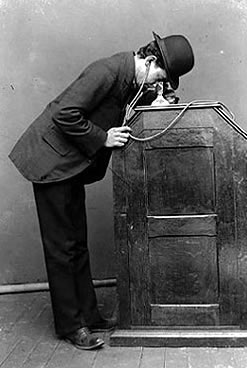
One
key invention that he can be a counted for is the Kinetoscope.
This device was an early motion picture device that was used for exhibition purposes, the device was
designed for one person to view through a peephole window at the top of the device. Although it
was a film device, it was not designed to be a movie projector, so introduced a
basic approach to the standard of cinematic projection before the invention of
video.
He
began to pursue the invention of motion picture development as he was inspired
by the photographic pioneer Eadweard
Muybridge.
The Lumiere Brothers - Auguste and
Louis or more formally known as the
Lumière brothers were the sons of the
well known portrait painter Antoine Lumiere,
they both held technical minds and always excelled at science and therefore
were sent to a Technical School. Due to the new financial photographic
processes discovered Antoine decided to
leave his passion for art and create a business manufacturing and supplying
photographic equipment. Louis later joined him where he began to experiment
with the photographic equipment.
During
his experiments Louis discovered a process that assisted the development of
photography. He began to develop a new dry plate process in 1881 when he was
just 17 years old. this became known as the Etiquette Bleue.
This process gave the business a welcoming boost. Later they built a factory to
manufacture these plates within the Lyons Suburbs.

By
the year of 1984 they had been producing 15,000,000 plates a year making there
father a very successful businessmen. At this
time Edison had created his tool the Kinetoscope
which they were invited to view, although being a very clever piece of
technology the brothers found many faults. With the key ones being the
equipment's overhauling size and weight which meant it must be kept in a studio
and secondly the fact that the equipment only allowed one person to see the
picture at a time. After finding these faults and improving on them the
brothers in 1985 had created there own
device called the cinematographe
which was a combination between a camera and a printer which was patented
February 13th 1985. With the device being very
lightweight and hand cranked at only 16 frames per second meaning that less
film was required and also the noise was reduced to make it run more quietly.
Louis’s most effective idea was incorporating a similar device to that of a
sewing machine, they decided to keep their invention closely guarded and then
only showed it to small groups with their first being a film of workers exiting
the Lumiere
factory.

Willis
Harold O'Brien - Born March 2nd 1886 and
died November 8th 1962, he was an American motion
picture, special effects and also a stop-motion
animation pioneer. who
according to ASIFA-Hollywood he
was responsible
for some of the best images in
cinema history, and is best remembered for his work
on the 1925 silent fantasy adventure
film and an adaptation of Arthur Conan Doyle's 1912 novel
The
Lost
World, King
Kong and The Mighty
Joe
Young, for
which he won the 1950 Academy Award for Best Visual Effects.
Raymond Harryhausen -
Born June 29th 1920 and
died May 7th 2013. He was an American visual effects creator,
writer, and producer who had
created a form of stop-motion animation which was known as "Dynamation." His most memorable
works included the
animation on Mighty
Joe Young which
he made in 1949 with
his mentor Willis H. O'Brien,
this won him the Academy
Award for special effects;
also known for his films such as The 7th Voyage of Sinbad, his
first color film;
and Jason and the Argonauts, which features a famous sword fight against several skeleton
warriors. With his last
film being Clash of the Titans before
retired. his innovative
style of special effects in his
movies has inspired numerous people including
directors John Lasseter
and Tim Burton. here is just an example of his work, showing the skeleton scene from Jason and the Argonauts which i spoke of earlier.
Jan
Švankmajer -
born September 4th
1934, a Czech filmmaker and artist whose works span over several media types. He is a self-labelled surrealist best known for
his animation and
features, that have greatly influenced others
including Animator Terry
Gilliam, and the Quay Brothers.
Švankmajer has gained quite an impressive reputation over a series of decades for his distinctive stop-motion technique, and the
ability to create surreal, nightmarish yet comical imagery.

His trademark includes exaggerated sound
effects, and often creating
a very strange effect in all of
his eating scenes. He has
often used fast-motion sequences
when people are interacting within scenes. With
movies often involving
a series of inanimate
objects to life through stop-motion
techniques. Many of
his films also include clay
forms in motion, which can also be known as claymation.
As well as these techniques he has also
been known to use pixilation in
many of his films
such as Food and his 1996 project the Conspirators of Pleasure.
Although a majority of his projects
such as the short
film Down to the Cellar, are
made from a child's perspective, at the
same time they are often truly disturbing and even have quite an aggressive nature. In 1972 the communist authorities
had banned him
from creating films,
and many later projects had been suppressed.
Making him almost unknown in the West until early 1980.

No comments:
Post a Comment